Showing posts with label book review. Show all posts

Tuesday, May 3, 2022

Book conversations: In the Shadow of Death

Through this book, the retired Director General of Police (Karnataka CID), Mr D V Guruprasad, presents cases of convicts on the death-row, with the hope of discerning the mental state of such criminals.  As he writes in the Preface, he was inspired by his encounters with late-stage cancer patients who experience hope, denial and depression in varying measures.

Mr Guruprasad has taken the trouble of interviewing several death-row convicts, some of whom have committed the most heinous crimes possible.  Of the many convicts that he meets, fascinating stories of eight are presented in this book, along with their post-crime mental state.  If not for anything, the individual stories presented in this book are themselves worth your time.  Though reprehensible, it is an eye-opening experience to find out about the extent to which one individual could stoop to, to get what he/she wants. 

Before I go into the discussions of the contents of this book, permit me to digress a little to talk about the psychosocial aspects of the criminal mind, which have a bearing on the contents.

Many of the criminals, and a majority of the prison population, would qualify for a diagnosis of Antisocial Personality Disorder (ASPD).  Therefore, it would be prudent to remind ourselves about the diagnostic criteria for ASPD before we proceed further. 

[Note: These criteria are according to the Diagnostic and Statistical Manual Version 5 (DSM-5) devised by the American Psychiatric Association for arriving at the diagnoses of mental illnesses.  There is also the International Classification of Diseases Version 10 (ICD-10), devised by the World Health Organization, in which ASPD is termed Dissocial Personality Disorder, but the diagnostic criteria are  largely similar to those of DSM-5].

ASPD is characterized by a casual disregard for, and violation of others' rights in all social situations.  This is indicated by 3 or more of the following:

  • Failure to follow social norms and law, indicated by repeated illegal acts leading to arrest.
  • Deceitfulness, indicated by lying, use of aliases, or conning others for profit/pleasure.
  • Impulsivity or failure to plan ahead.
  • Irritability/aggressiveness, indicated by fights/assaults.
  • Reckless disregard for safety of self/others.
  • Consistent irresponsibility, indicated by failure to have gainful employment or to meet financial obligations.
  • Lack of remorse, indicated by indifference or rationalization (explaining away) of problematic behaviour.
The above features should have started before 15 years of age, but the diagnosis of ASPD is made after 18 years of age.  This means that there could be precursors to troublesome behaviour even in the early developmental period, which often go unchecked, leading to the eventual ADHD in adulthood.  It is worth noting that a majority of the individuals with ASPD are men.  

One might also add loss of empathy (inability to understand others' feelings/suffering), and loss of insight (inability to fathom one's own problematic behaviour and accept help/treatment for the same).  Non-empathetic behaviour implies that individuals with ASPD see and treat other people like inanimate objects that they can abuse for their own personal gain.  

Further, loss of insight means that they fail to understand the gravity of crime committed by them and instead apportion the blame onto others (this is qualitatively different from the loss of insight one sees in psychotic conditions such as schizophrenia, in which the individual firmly adheres to the delusional belief in spite of evidence to the contrary).  Put simply, for individuals with ASPD, the whole world is at fault, except themselves.

However, crime does not always have to be due to underlying ASPD.  In many cases, crime occurs due to the complexities of the human mind; its hypocritical, sensitive and inconsistent nature that renders it vulnerable to exaggerated reactions to trivial provocations.  Since most of us interact with the world through our ego, or the lower self, our interactions are laced with deep disappointments and resentment due to unmet expectations from others around us.  

In the oft repeated nature versus nurture debate, it is important to remember that in the context of human personality, both are important.  Of course, there could be genetic and hereditary influences on deviant personality, but if the upbringing is good, and the early childhood environment is conducive to good psychosocial development, the adverse effects of genes could be mitigated to some extent.  I have documented this in an earlier work on a family whose many members had mental illnesses, with the sole exception of an elderly matriarch who displayed remarkable resilience and fortitude in handling the situation amicably.  

Spiritually, it is said that the karma we bring with us to our human existence compels us to behave in ways that can generate more karma, good or bad.  We can use our free will to act and behave in ways that can minimize the effects of bad karma and enhance the possibility of accruing good karma.  However, in reality, unless one is an advanced seer, this is easier said than done due to the effects of mind/ego.  

We easily forget that nothing and nobody is under our control; we forget we need to accept people for what they are, and that it is okay for others to behave contrary to how we would in a given situation.  The mind with its ego rules over us, compelling us to behave in often unproductive and even harmful ways.  ASPD and other personality disorders happen to be products of the vagaries of the human mind/ego, and indeed, bad karma.  

With this background, let us now delve into the individual cases presented in the book briefly (these are my personal views on these cases without any spoilers; for more specific details please read the book).

Rohan: He can qualify as the Ted Bundy of India, although the latter is said to have been even more creative in the violence he inflicted on his victims (please see films on Bundy, such as Extremely Wicked, Shockingly Evil and Vile, 2019).  Rohan befriended women and made away with their valuables after killing them.  

I was struck by the extent of gullibility of all his female victims who fell for this ploy.  Indeed, this is one of the enduring mysteries of our existence: like moths drawn to fire, seemingly smart women blindly trust conniving conmen to the point of self-negation.  Even if they survive, they continue to live in abusive relationships, something that can perhaps be explained by the psychological phenomenon of learned helplessness - giving up trying to escape an adverse situation even when escape is possible -  which I have observed in abused women that I have seen in my medical practice.

The Dandupalya gang: There appeared to be interesting group dynamics within the gang, alternately bickering and uniting with each other, opportunistically.  They were probably bound together by the common cause: crime, and escaping the consequences of such crime, which gave a cultish feel to their gang.  At least one member of the gang displayed the tendency of getting high on killing others; a fascination for the act of murder and bloodletting.  Given the multiplicity and the heinous nature of their crimes, it is appalling that the otherwise disparate group stuck together in the vehement denial of its wrongdoing, and one of the reasons for this appears to be the shared loss of insight described under the ASPD criteria above.  

Pushpa: This a rare case of female ASPD, with the additional problems of insatiable greed, and an inability to stay away from the act of murder, ostensibly to steal the valuables of victims, but really, I suspect, due to an addiction.  As in the gang above, any action that activates the reward mechanism in the brain (any action that triggers dopamine release in certain brain areas resulting in pleasurable emotions), can result in the individual becoming dependent or addicted to it.  

Be that as it may, her modus operandi was particularly problematic because she took advantage of her victims' vulnerability and conducted sham religious procedures to gain their confidence and kill them.  Fakery such as Pushpa's leads one to cast aspersions on even genuine practitioners of Sanatana Dharma.  Besides, her actions play right into the hands of the so-called rationalists who have a particular predilection for venting vitriol on Hindu rituals.   

Mahesh: Who said that big burly men do not cross-dress?  Yet another case of ASPD, Mahesh yo-yoed between sexually assaulting female victims and surreptitious transvestism.  It is particularly disconcerting to note that a law enforcer could turn into a law breaker and evader, which once again goes to highlight the tenacity of the criminal mind that compels one to become so. 

Suresh: For a change, this was a convict with no signs of ASPD, but he did seem to have the affliction of another kind, something which can affect any one of us.  As described above, a small word with a big problem: ego.  Hurt by the fact that one of his female relatives preferred marrying somebody else, he went on a killing spree of his family; possibly a suicide-pact that went horribly wrong.   

Sairam: Sometimes circumstances force a person to take matters into his own hands, and this man was unlucky to have had two deceptive wives.  He too, is unlikely to have had ASPD.  His case begs the question, how would we react if we were faced with a similar predicament?

Srikant: Once again, ego was hurt at the fact that a female relative that he had an incestuous feeling towards was seeing somebody else.  Like most of the cases included in this study, he too denied any wrongdoing on his part.  

Sanjay: Can alcohol blackouts be used as defence against a murder charge?  Medically, we know that alcohol increases risk of both suicide and homicide since it is a disinhibitant; that is, it takes away the usual restraint and grace that we exercise in our social relations.  The answer is probably no, because alcohol can be seen as a lifestyle choice that the perpetrator willingly indulged in, in the first place.  Sanjay probably also had dissociative episodes (loss of memory/control during stressful periods) while killing his family.  The cause for his breakdown appears to be typical marital strife that usually leads to intensely emotional upheavals and high stress and duress.

If unearthing the nature of 'death-row syndrome' is the primary purpose of this work, it is, as the author himself admits, not achieved.  There appear to be two main reasons for this.  Firstly, as Mr Guruprasad  suggests in the Afterword, the convicts appear to have been instructed by their lawyers and fellow inmates to maintain their innocence with everyone they meet, especially with a visiting policeman.  This is because they live in the hope of being released early, given the changing nature of our jurisprudence, differential application of law, and the whims of the deciding/appellate courts, judges and other authorities.  

They take heart from the fact that in several previous cases, convicts have benefitted by such largesse, and at least on one occasion, a retiring President of the country had commuted the sentence and paved the way for early release of many similar convicts.  The professional hangman that Mr Guruprasad interviews, also observes that almost none of the convicts he has hanged expressed regret for their actions, and some have resorted to the art of malingering - deliberately harming oneself or feigning symptoms of illness - to escape the noose.  

Secondly, I suspect that there could be a deeper reason for such blatant denial: the lack of insight described above under the ASPD criteria.  Many convicts actually believe in their innocence, and would do anything to rationalize their acts and shift the blame onto the victim, arresting police officers, judge, judicial system, etc.  In any case, the entire situation appears to be vastly different from what one encounters in the western countries, where there is an air of finality to the sentence, and convicts are likely to actually display the 'death-row syndrome.'  [Note: please seen excellent fictional film adaptations of real-life stories; e.g., Trial by Fire (2018) and Clemency (2019)].

I have worked in Forensic Psychiatry service while in the UK, wherein criminals who are mentally ill, or, conversely and more importantly, persons with mental disorders who commit a crime, are managed.  There is a lack of forensic psychiatric services across India, barring a few major centres.   Here, they tend to be managed in prisons by the resident doctor, who, at best, can provide only basic medical care.  

Hence, the problematic behaviour and/or psychiatric issue, notably ASPD, remains unaddressed  and mismanaged.  This in turn has a bearing on the recidivism rates, which remain high even in the presence of robust forensic psychiatric services.  This explains why convicts are liable to commit similar or other crimes upon early release from prison.  In between incarceration and being released, either through bail, furlough, or a commuted sentence, there is hardly any forensic psychiatric care available, putting both the perpetrators and their victims at risk.  

I am no legal expert, but like any law-abiding citizen, I do feel strongly about cases where gross injustice was done towards the victims.  Overall, there appears to be a lot of slips between the proverbial cup and the lip as far as serving justice is concerned.  As the saying goes, there is plenty of law in our courts, but not enough justice.  From diversion tactics, to subverting evidence, to changing statements, to feigning illnesses, to hoping for a commuted sentence, a convict and his/her representatives can take advantage of the many loopholes in the judicial system.  

The elusive nature of truth, and the almost impossible task of proving guilt 'beyond reasonable doubt' ensure that justice, sadly, for many of the victims described in this work and otherwise, remains a myth.  None of the convicts presented in this book have been hanged, and many are living in the hope of having their sentences commuted.  This is probably the reason why Mr Guruprasad has not found any significant mental illnesses, notably depression, among many of these convicts (unlike late-stage cancer patients who inspired this work).  

Which brings me, finally, to the touchy subject of capital punishment.  There have been raging debates about the veracity of this punishment method.  On the one hand, almost all victims (of other cases) and their families have expressed the wish that the convicts responsible for those cases be hanged.  On the other hand, the self-appointed guardians of human rights have cried foul and argued that capital punishment is barbaric, retributive, and has failed to act as a deterrent of further crime.  

This debate raises a few other germane questions.  Why can't punishment, including death penalty, be meted out proportionate to the crime committed in individual cases, regardless of whether such punishment acts as a deterrent of future crime or not?  What about the legal loopholes that a convict has recourse to, indeed, even that convict who has committed the 'rarest of rare' crimes?  What about the human rights of the victim who suffered at the hands of the convict?  And what guarantee can those against capital punishment provide to ensure that recidivism rates are addressed, and the released convict will never revert to his/her old behaviour?  If capital punishment is to be done away with, can the existing jurisprudence guarantee that a hardcore, incorrigible convict would be kept incarcerated till the end of his/her natural life, with no recourse to appeals, bail, furlough, or a commuted sentence?  

This, of course, is unlikely to happen because, only recently, the Supreme Court stated that the right to furlough of a convict cannot be foreclosed since it is 'an incentive towards good jail conduct.'  It is worth noting that the said convict in the case had had his death penalty commuted to life imprisonment by the President of the country with the condition that he would remain in prison 'for the whole of the remainder of his natural life without parole and there shall be no remission of the term of imprisonment.'

Both the parties in the capital punishment debate, I suggest, are missing the larger point.  Spiritually, it is said that nobody has the right to take the life of a fellow human being, no matter what he/she has done, whether it is the case of a criminal killing his victim, or a vigilante seeking retribution.  Our scriptures tell us that killing another person should be the last resort, an action that is undertaken under strict dharmic conditions when all other strategies have been exhausted.  Further, the karmic theory holds that each person should be given the chance to live out his/her karma to the fullest extent so as to facilitate their spiritual progress.  

Having said that, allowing a criminal to run riot and maim/kill others, and putting up with the inflicted injustice passively, are also adharma.  This is where the state, as the parens patriae of its people, has to step in to maintain the fine balancing act of ensuring the safety of its citizens on the one hand, and providing medicolegal and psychosocial care to convicts on the other.  This, as we have seen in multiple examples from this book and elsewhere, is easier said than done.   

If we can find the answers/solutions to these larger questions/issues, we can hope to come close to solving the conundrum of capital punishment, and indeed, meting out equitable and timely justice in all cases.

Mr Guruprasad candidly admits that this is a limited study: a single individual's effort in collecting anecdotal evidence from a limited number of perpetrators from a single centre.  Going forward, the subject of death-row syndrome requires a multi-centre, objective study of convicts' mental state using standardized tools of measurement.  

Having said that, this work is a thought-provoking attempt at understanding the criminal mind, which also serves as a grim reminder of the potential for evil that is lurking in the human mind.  Only by acknowledging and studying and managing this potential can we hope to create a safe society, and to this end, Mr Guruprasad's work is a worthy addition.


References/resources:
Image source: https://www.amazon.in/Shadow-Death-Stories-Convicts-Penalty-ebook/dp/B09MQRTDVL
Furlough news source: Apex court says no blanket denial of furlough to life convicts, Deccan Herald, 30 April 2022.


Monday, November 15, 2021

Book conversations: India's Most Fearless

Two things become clear when you read this book on Indian armed forces' operations.  

One, Kashmir, or to be more specific, POK, continues to be the white elephant that has drained India's resources in terms of wealth and manpower over the years.  

Two, our security forces have been engaged in and successful at carrying out Zero Dark Thirty type of operations since ages.  

Aroor and Singh present several stories of bravery and sacrifice from the battle frontlines, encompassing all three divisions of the armed forces: army, navy and airforce.  These are stories that needed to be told, because, with the exception of Uri and Shershaah, not many make it to mainstream media, save a tiny newspaper report or a posthumous gallantry award.

From these stories one can get an idea as to the mindset of the soldiers who went into combat knowing fully well that the price to be paid was their lives.  One can glean this from some of the memorable quotes attributed to the soldiers themselves:

'...he was married to the adrenaline of combat.' (on why a certain soldier took risks in combat)

'Only soldiers who have bled together in combat will understand that.' (on what it is to be injured in combat)

'Lead your life.  Don't let life lead you.' (advice given to a soldier by his father while enlisting)

One hopes that the powers that be take timely affirmative steps to address the threat posed by hostile neighbours that we are surrounded by so as to mitigate the loss of lives of our brave soldiers.  In addition they also need to look at the threat that is already within the country, thanks to the lax border restrictions and indifferent deportation strategies.  

We also live in hope that attacks are prevented rather than fire fought, and if that calls for more surgical strikes, then so be it.  Especially so because the perpetrators of some of the major attacks are safely ensconced in havens across the border.

That this book has spawned a second volume of further stories of bravery and sacrifice is testimony to this ongoing threat, which in today's world is covert and subversive.

We wish our armed forces health and safety and all the success in countering the same.  


Picture source:
https://www.amazon.in/Indias-Most-Fearless-Stories-Military/dp/0143440446/ref=tmm_pap_swatch_0?_encoding=UTF8&qid=&sr=

Monday, September 14, 2020

Book recommendation: Laws of the Spirit World


As I have said with other book recommendations, there are times when you do not read a book for its literary merits.  Rather, you read for the content: the message it conveys and how it will affect you.  

This is one such book.

You might have wondered to yourself, what is life?  What is the purpose of our existence?  What should our life goals be?  Why do have relationship issues?  What should we avoid doing?  How are we doing in terms of achieving our goals in the phenomenal world, and in the spiritual sense?

If so, then this book is for you.

It only requires two things of you: belief and an open mind.  You won't be able to progress much if you don't believe the source of the messages contained in this book.  Secondly, if you are the ultra-rational type, who seeks a logical explanation for every occurring, then too, this is not for you.

Apart from the answers to larger issues mentioned above, here is a sample of the some of the words of wisdom that I perused in this book - spiritual mahavakyas, if you like:

  • 'Yes, God exists!'
  • 'Suicide is sin.'
  • 'Murder is never part of God's plan.'
  • 'On Earth, wise men created marriages to safeguard children...'
  • 'Nothing happens before its time - so just wait and relax...'
  • 'Do not be judgmental, but use your judgment.'
  • 'Choose goodness for the sake of goodness itself.'
  • '... all thoughts create energy, so be aware of what energy you are creating.'
  • '...hope is essential to human survival.'
  • 'Positivity is a choice no matter what the situation.'
  • 'Fame on Earth has absolutely no value in the spirit world.'
  • 'To do God's work means to use your position of strength to help others grow.'
  • 'Whatever your path, learn to view it from a spiritual perspective.'
  • 'Instead of feeling great, feel grateful.'

Though it is clearly mentioned in the book that 'there is no religion in the spirit world,' I could not help noting the obvious congruence of the messages with those of the scriptures of Sanatana Dharma.  

So, here are a few that indicate this:

  • It is not God, but the Law of Karma that punishes us for our misdeeds.
  • One can accrue both negative and positive Karma, according to the nature of our actions.
  • '...reincarnation means the same spirit being born on Earth life after life.'
  • 'Take action.  Do your best and leave the rest to God.'  [To me, this is a direct vindication of the overarching message of the Bhagavad Gita: do your duty and don't worry about the results.]
  • 'Yoga is wonderful for the mind, body and spirit.'
  • 'To know God is to know ourselves, discover who we are, and discover His goodness within us.' [Confirms the message of spiritual unity of all living beings with Brahman, as propounded by Adi Shankaracharya's Advaita philosophy]
  • 'True success is spiritual success and not earthly success.' and 'Do not think of power.  Think of spiritual strength.' and 'Lead a simple, honest, kind and selfless life.'  [underpin the importance of viveka (discrimination), vairagya (non-attachment) and nishkama seva (selfless service), that are advocated for spiritual progress in Hinduism]
  • 'The things that you can see are temporary; the things that are not visible are eternal.' [indicative of maya, which is the attribute of the phenomenal world that prevents us from realising Brahman, once again, from Advaita]
  • 'There will come a point when Nature itself will erase negativity.'  There is also mention of 'shift of Earth's axis' and natural disasters that will wipe away negativity caused by human vice.  [comparable to pralayas (great dissolution of creation) that end each of the four yugas (time periods) mentioned in the Bhagavata Purana]

Bear in mind the spirit communications delivering these messages are from two recently deceased Parsi gentlemen to their mother.  Just like in my other book recommendation, Many Lives, Many Masters, it is reassuring for me to know that our rishis have, over the ages, given us the message of spiritual enhancement, which is only recently being vindicated by non-Hindu thinkers/writers and through scientific studies. 

Even if you are a sceptic, it wouldn't hurt to learn through the messages conveyed in this book and put them into practice, if only to become a better human being.

Highly recommended reading from an early age, so that we know what really matters in life and over what pursuits we need to invest our time and energy during our lifetime. 

Thank you, Vispi, Ratoo, Khorshedji and Rumiji.  May you reach the highest Universe and Realm.


Image source: https://m.media-amazon.com/images/I/514KGkGN84L.jpg


Monday, January 28, 2019

Book conversations: Sky-clad (including interview with author, Mukunda Rao)


Mukunda Rao, author of Between the Serpent and the Rope, presents the extraordinary life-story and message of one of India's most charismatic female saint-poets, Akka Mahadevi.  

Apart from Akka, Sky-clad provides the accounts of illustrious female saint-poets of India: Meera, Andal, Lalleshwari, etc.  It also provides a historical glimpse of the foundation of Virashaivism by Basaveshwara and the movement's probable guiding force, Allama Prabhu.

This unique form of bhakti movement incorporated the worship of Shiva in an impersonal and/or Linga form, whilst striving against varna/jati restrictions.  While Basavanna's personal god was Kudala Sangamadeva, Allama Prabhu's was Guheshwara, and Akka's Chennamallikarjuna - all different manifestations of Lord Shiva.  The ultimate goal of these and other sharanas was the same: aikya, anubhaava, sunyata, moksa, nirvana, enlightenment or the natural state.  

Rao writes about Akka's early life, her struggle with the unnecessary marital bond that she is forced to accept due to the machinations of a smitten Jain king, Akka's flight from the bondage when her husband is unable to observe her conditions of marriage, her trial at Kalyana by Allama, her spiritual quest, and her attainment of aikya at the Srishaila caves.  Sky-clad ends with a collection of Akka's vachanas.


*****

A major part of the book is dedicated to the agony of separation and yearning for ultimate dissolution with the god-principle that is inherent in bhakti philosophy.  Even though Akka's nakedness when she exits the marital bond and wanders in search of her istadevata is looked down upon by some of her contemporaneous saint-poets, we find through Rao's writing, that the transcendence of gender limitations and social strictures is a common theme in the writings of even male saint-poets of the time, including Basavanna.

Sex, gender and sexuality are assumed to be fixed.  This notion of fixity may pertain to the physical sex, but gender roles and sexual orientation are very fluid and characterized by wide variations in their expression.

Other writers (referenced below) have pointed out that regardless of the physical sex of the vachanakara, in madhurya bhava form of bhakti, the androgynous nature of these saint-poets is evident in their vachanas.  Consider these examples from  male vachanakaras (ibid.):

When I saw him,
I forgot the eight directions, O mother,
O mother, mother
When I got him to speak to me
My entire body broke into sweat
What next O mother?
Today when Mahalinga Gajeshwara
Is embracing 
I have forgotten
To embrace him...
What next, O mother?

And:

In my great rapture
Of making love with my darling
I can't tell myself from the world.
While making love with my darling
I can't tell myself from my darling
After making love with Urilingadeva
The god of the burning member
I can't tell whether it is me, him
Or something else.

Further, this fusion, confusion and inversion of gender roles is also dramatized in Jayadeva's Gitagovinda in which Radha is shown dominating Krishna (ibid.):

Driven by love's fever
Radha rode her lover
Trying to dominate him...

This theme is also reflected in female vachanakaras' works: Remavve, the spinner saint-poet is quoted as saying, 'Other husbands are above; Mine, below.'  And Akka herself wrote (ibid.):

I will capture 
The Foe of Kama
O Basava
Thanks to your grace
I will capture 
The Moon-wearer
O Basava
Thanks to your grace
I will create obstacles
For the extremely licentious lord
Channamallikarjuna
And mate with him
As if we are not two.

*****

I asked the author about these and other topics of interest covered in Sky-clad.  Here are excerpts from the email interview with Mukunda Rao:


1. To begin with, I was a bit unsure of some of the dates mentioned in the book.  Firstly, in the introductory pages, the date of Bhagavad Gita is given as 100 CE.  Is this the date the Gita was first documented?  Because the date of the Mahabharata war has been variously given as 950-3102 BC, and if the Gita is part of Mahabharata, it would be much older than mentioned.  Secondly, in page 35, the Aihole temple is credited as the first Jain temple, pre-dating Hindu temples.  I am assuming this is only in Karnataka?  Because elsewhere in India there have been much older temples dedicated to Hindu deities.  Even within the Aihole temple complex, which has Hindu, Buddhist and Jain temples, the date of the Jain Meguti temple is given as 634 CE, whereas the Ravanaphadi cave temple dedicated to Lord Shiva is said to be constructed in 55o CE.
MR: Dates or 'origins' are always controversial.  However, the truth of the matter doesn't necessarily get enhanced because it's older.  I am not a scholar, nevertheless I do necessary research and try to be careful in what I say.  The Mahabharata was in oral form for centuries before it was written down.  The time frame traditionalists offer is suspect; Mahabharata, I think happened after the Buddha period, also its composition.  Statues, figures and paintings of the Buddha and Mahavira seemed to have appeared centuries before the Hindu temple culture grew and spread widely.  Perhaps 'Linga' was much older, not Lord Shiva with a crescent moon in his hair.  Anyway, I don't want to hold on to these dates; tomorrow there may be new findings and we stand open to corrections.

2. Regarding Meera's bhakti there is mention of viraha - the pangs of separation, which is expressed in her numerous songs.  You have written that in this type of bhakti, the bridge of separation between the devotee and deity is never crossed.  However, according to the recorded biography of Meera, she is said to have merged into the image of Lord Krishna in the temple at Dwaraka.  Meera's sari is said to have appeared on the Lord's idol, indicating the final union.  Can this then be taken as proof of the ultimate dissolution?
MR: It is said even Andal merged with the deity.  This only indicates the intensity of their bhakti.  Bhakti is relational, thought it has within it the great urge to transcend the duality.  Only a few lucky ones cross the bridge.  This is not to privilege some bhaktas over others, but only to point out the nature of bhakti and its spiritual consequences.  I have tried to follow more their poems rather than legends.

3. In the sections on bhakti, and body and gender, you mention about gender issues and feminine beauty as impediments to spiritual progress.  While the Freudian theory of penis-envy has been rejected by later day female psychotherapists, I was wondering if there could be an opposing theory at play in male sharanas who identify their gender as feminine when it comes to expressing bhakti towards the male God.  Could the male spiritual aspirants be envious of women's Janani status, and therefore yearn for fulfilment from a higher male power?  It is also interesting to note (from the book referenced below) that Maya, the evil that separates the devotee from the deity is mostly construed as female by almost every seeker, but Akka Mahadevi has described it in the masculine gender in one of her verses (ibid.).
MR: You have a point and an interesting one.  Sexuality and its experience seem to play a significant role in shaping the language of bhakti.  Male bhakta could be envious of female bhakta.  Vagina is a receiver, so male bhakta may want to be that receiver receiving love, grace and jnana!

4. We tend to have a hypocritical attitude towards matters of sex, in that we act as though it does not exist, and brush all matters related to sex under the carpet, even though our growing population suggests otherwise.  Sex is certainly considered to be an impediment to spiritual progress by almost all religions.  In this context, it is very interesting to note the explicitly sexual connotations that are present in Akka Mahadevi and her fellow sharanas/sharanes' poems.  Akka talks about going "cuckold my husband with Hara" and "fornicating with Shiva" (ibid.).  Are these sexual connotations to be taken literally?  Did the bhaktas really aspire to have actual physical contact with their chosen deity?  Are the erotic carvings on some of our temple walls giving us a message of some sort, perhaps relating to the importance of sex in spirituality, something that we have failed to realise?
MR: How is actual physical union possible?  Only the yearning for union, which is the yearning to transcend duality, is expressed in sexual terms.  As I say in the book: 
The strong sexual imagery in the last vachana is actually indicative of the deep yearning for mystical union - the expression of this ultimate union, or the great urge to self-transcendence, is in physical terms.  The physical becomes the heart and soul of the metaphysical.  In the way of bhakti, the poet joins the bodily experience with the transcendental so that the spirit speaks through the flesh.  For, the body, as Akka would say, is not only the 'house of passion' but also the 'home' of the Divine.  So the physical continues to be the base, even when, at some point during this journey, her Lord Chennamallikarjuna, with 'white teeth' and 'matted curls,' metamorphoses into nirguna, or the aniconic one, who has no attributes; and finally, into the nirakara, one with no name or form.

5. In page 75, you talk about Allama Prabhu, Jiddu Krishnamurti and U G Krishnamurti's pathless path, wherein they reject the notion of accumulation of knowledge and performing sadhana to attain enlightenment.  Is there no meaning in seeking guidance from a guru, which is considered to be an essential prerequisite to progress on the spiritual path?  How does on conduct oneself in life if one is a spiritual aspirant desirous of attaining enlightenment?  Is luck the only factor that results in one progressing from anubhava to anubhaava?

MR: The need for gurus, sadhana and jnana is quite necessary, or at least the necessity is there in every quester's life.  We need all these tools when we start the journey, but somewhere along the line, they drop off one by one and one is on one's own.  A genuine quester cannot be dependent on a guru forever, and a genuine guru would certainly want to release such people from the circle of his influence.  In other words, what we know is that that state of being cannot be brought about by an act of will, or engineered, or replicated, through any method or sadhana whatsoever.  At best, sadhana can prepare the ground and yet there is no guarantee.  The search cannot bring it on, only the end of search, if at all.  But then of course, there has to be a search for it to be abandoned, the search which ceases with the realization that the very search is the barrier.  It is the realization of the mind that it cannot solve the problem it has itself created in the first place. 
Intense anubhava takes you thus far but no further; for anubhaava to happen we let go all anubhavas!  Rest is luck or grace or whatever that is, we have no clue.  I called it the 'second missing link,' that which catapults one into the natural state of being.
 
*****


To me, the overarching message of Akka's life is this: one has to transcend norms and remain resilient until the goal is achieved.  Akka transcended physical inhibitions and social strictures as she set out on the spiritual path, and demonstrated amazing resilience in standing up to societal barbs and naysayers until she achieved her ultimate goal of aikya.  This is something each of us can learn from, whatever the nature of our individual goal.  

Rao's account of Akka Mahadevi's life and message is highly recommended reading for spiritual aspirants in general, and for those seeking to know more about one of the most fascinating female saint-poets of India.


Reference:

Androgyny and Female Impersonation in India: Nari Bhav, T. Mukherjee & N.R. Chatterjee, Niyogi Books, First Edition, 2016.  Chapter title: The Soul In-Between: Gender, Androgyny and Beyond in Bhakti Poetry, The Example of the Karnataka Veerashaiva Tradition, H.S. Shivaprasad, pp. 71-82.


Image source: 

https://www.amazon.in/Sky-clad-Extraordinary-Life-Times-Mahadevi/dp/9386850850


Wednesday, January 23, 2019

Book conversations: The Dhoni Touch


I had said that Dhoni must be the avatar of Cricketing God after he tormented RCB throughout IPL 2018 - CSK's comeback year.  

This book by Bharat Sundaresan tells us exactly why he is that avatar.  

While the Dhoni biopic gave us details about his personal and cricketing journey, this book by Sundaresan is less about Dhoni's cricketing acumen and more about him, the person; his enigmatic personality, character and mental state.  In effect it is a nice case study of a very different kind of cricketer, one who has given us his own brand of cricket.  

However, Dhoni the person, remains elusive throughout the book since he never grants the author the coveted one-on-one interview.  Instead, what he grants is access to some of his close confidantes that he has allowed into his inner circle over the years; his bosom pals, army colleague, ad director and selector.  Just these, not even his family members.  So Sundaresan has the unenviable job of piecing together Dhoni's personality traits from third person accounts, so that a cohesive picture emerges, however incomplete it is due to the non-participation of the man himself.

Nevertheless, what emerges is no less fascinating.  We learn that Dhoni is a self-made man, who never really set out to be a cricketer, but excelled in it nonetheless.  He is supremely confident in his own abilities and decisions, which he makes with a full sense of personal responsibility.  

He keeps thing simple, in the sense that he only controls the controllables, and understands that not everything can be fully achievable.  This leaves him free from mental clutter that can cloud his decision making ability.  It also helps that Dhoni has an uncanny ability to observe everything and everybody that is in his peripheral vision.  Apparently, he can also accurately read situations, and people and their intentions.  In that respect, he is an able if unconventional leader of men - a quality that has made him - thus far - India's greatest captain in all formats of the game.  

I also gleaned from the book that Dhoni possesses an outgoing and active type of personality, in that he is very much a movement kind of person and is fascinated by motion: that of the body, or anything that moves the body.  This might explain his deep interest in football, the rigours and manoeuvres of the army, his lightning quick reflexes behind the stumps, and riding bikes: 'Do you know the feeling of riding at 225 miles an hour and the breeze hitting your chest?' as the man himself asks.  

Dhoni also enjoys taking risks, which explains his penchant for leaving the run-chase till the last over when he seals it off with a six over long-on - leaving us breathless and squirming in our seats.

This is not to say that Dhoni is extroverted in any way.  Indeed, he is known to be a very private person who is relaxed only with his inner circle of close friends and relatives, and absolutely abhors media interactions.  

This is what I have gathered from The Dhoni Touch: even though Dhoni's first love was football, it is hardly surprising that cricket ended up being his prime vocation.  Cricket, as we know is a complex, complicated, unpredictable and enigmatic sport, and so, it emerges from this book, is Dhoni's personality - cricket and Dhoni probably attracted each other.    

This is implicit in Sundaresan's summing up of the Dhoni personality towards the end of the book:

A man who was not born to be a cricketer but became one.
A man who was not born to be a captain but became one.
A man who was not born to be a legend but became one.
A man who was born to be an enigma and will always remain one.

Let's hope that this enigma will continue to don the India blues for a long time to come and give us many more breathless moments.  


Picture source: https://www.amazon.in/Dhoni-Touch-Unravelling-Enigma-Mahendra/dp/0143440063


Thursday, December 28, 2017

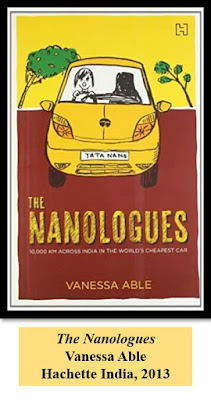
Book conversations: The Nanologues


If I were to tell you that somebody bought a Tata Nano car... you are likely to react by saying, 

Why!! Of all the things...

If I were to add that that somebody went on a round-trip of India in the Nano... 

Whaaaat!! No way...!

And if I were to add that that somebody happens to be a woman... 

Gettouttaa here...!

And... this gets better... that somebody is a British woman; a foreigner who has no driving experience in India... 

Aaaaargh!!! [while jumping up and down in disbelief and banging your head against the wall...]

That's just what this is about: a single white woman on a trek around India in a Tata Nano car, and somehow completing the journey to tell her tale. 

In this engaging account, Vanessa Able combines statistics, politics, culture, lack of road etiquette/discipline/decorum/courtesy that is all too familiar an Indian trait, and of course, the experience of driving a Nano which is symbolic of India's economic rise. 

Or at least it was, when it was first launched. It has since lost its place in the arch-lights in the wake of other brand innovations.  

To be fair to Nano, this review is four years too late.  In this period, the leading car maker, Maruti has come up with its own technological marvel that is holding sway currently: Maruti Celerio - the gearless wonder, which I happen to drive currently.  And I can vouch for the ease of driving experience of the Celerio (but not the lofty fuel efficiency that the company claimed at the time of its launch). 

The AMT gear technology of Celerio has caught on so well that Maruti has forced other companies to include this in their own models.  Tata Nano recently has followed suit recently.  Also, Nano is no longer available as the Rs-one-lakh car; all of its variants are now priced above two lakhs. 

[Update 2022: Celerio too has bitten the dust; the AMT system in my car simply stopped in the middle of traffic, and I had to sell it :(]

This book is also about driving, and the exasperating experience that driving is in India. In a reverse of Able's experience, I have driven for eight years in various parts of the UK during my days in the NHS - sometimes up to 100 miles in a day - and I can fully empathise with her predicament.  

The difference in driving experience in between the two countries is the same that exists between chalk and cheese.  Don't even try to understand the absence of any road-virtue in our culture, although I did make an attempt to address this issue in Angst.

Able's love for the Nano is evident throughout the book, whom she personifies by naming 'her'.  This is essentially a road-book, akin to a road-movie; if that's the genre that appeals to you, then this is right up your street...!

I hate driving on our roads... but it is really awe-inspiring that somebody 'enterprising in a good way' such as Able has taken the bull by its horn and survived - if you leave out a few bumps and scratches. 

Therefore, it gives me immense pleasure in saying that Vanessa was Able to fulfil her Abhilasha before saying Tata to India...  Sorry, couldn't resist that one...!


Image source: https://images-na.ssl-images-amazon.com/images/I/51VPtVJer4L._SX322_BO1,204,203,200_.jpg


Sunday, December 3, 2017

Book conversations: Fatal Margin


I had written about how rare it is to find a fellow doctor-writer, given the fact that doctors have to surrender themselves to their demanding schedules and recalcitrant patients.  Not only have I, through the course of my diverse readings, managed to unearth a gynaecologist-writer, but now I have discovered a surgeon-writer! 

And if the said writer happens to be a relative of a doctor colleague/family friend, the curiosity level reaches a new high. 

Fatal Margin, therefore, was a highly fascinating prospect for me; more so because Dr Umanath Nayak attempts to do the unthinkable: enter the realm of Robin Cook and churn out a medical thriller.  While this in itself is an admirable undertaking, Dr Nayak also manages to add to the premise such ill-discussed issues as medical-political-corporate intrigues, and nepotism and corruption in the medical world. 

The result is a heady mixture of medical protocols and statistics, political manoeuvring, and courtroom drama.  Dr Nayak utilises his considerable surgical oncology expertise to etch a character called Veer Raghavan who is an ambitious surgeon looking to establish the foremost cancer centre in the country.  In the process, he circumvents a few rules and rubs a few powerful people the wrong way, and courts trouble.  Rather, trouble takes him to the court! 

How he manages to save face and emerge victorious in the face of seemingly insurmountable evidence against him, is what the story, leading up to the climax is all about.  

More than the thriller and mystery elements, to me, the standout feature of the story is the courtroom debate about what constitutes truthful and untruthful, acceptable and unacceptable, and ethical and unethical practice of medicine. 

Is it alright to overlook a few medical errors for the sake of the larger good of society?  Is evidence-based medicine superior to and preferable to value-based medicine?  Dr Nayak tackles these issues, which fall within the medicolegal grey area, admirably.   

Lay readers can look forward to an introduction to medical jargon and standard medical practice.  Fatal Margin is a valuable addition to the cause of Indian medical-fiction.   


Image source: https://images.gr-assets.com/books/1418439911l/23793071.jpg

Saturday, August 26, 2017

Book conversations: Between the Serpent and the Rope


For those of us who are spiritual aspirants, it is common practice to familiarize ourselves with the various spiritual folds and tenets, especially in the early exploratory phase.  

This, in essence, is the subject matter of this book.  Mukunda Rao records his own experiences from his peregrinations of famous spiritually important places of South India.  

Rao moves from Kalady (birthplace of Adi Shankaracharya), to Arunachalam (Ramana Maharshi's place), to Auroville in Pondicherry (home of the Aurobindo movement), to Puttaparthi (the Satya Sai Baba stronghold), to Mata Amritanandamayi's ashram, to Sri Sri Ravi Shankar's Art of Living campus, to Adyar (Jiddu Krishnumurti's main place of work in India), to finally finish with U G Krishnamurti's timeless, dogma-less, disciple-less and ashram-less concept of spirituality.

In so doing, Rao combines the details of his stay at and encounter with the people of these places, the rise and fall of the prominent religious/spiritual figureheads of some of these places, and his own take on the philosophies expounded by each of these gurus.  The result is a book that is at once a travelogue, a series of biographies, and an elucidation of the different spiritual theories of South India. 

Intriguingly, Rao comments on the failure/modification/misinterpretation/inadequacy of some of these philosophies, and the blind hero-worship that persists even after the founder-philosopher is no more.  Thus the idea behind the movement assumes gigantic proportions, and subsumes and supersedes even the founder-philosopher (for example - and this is my own take - the two Abrahamic religions; Christianity and Islam). 

In many ways, the preceding chapters are a build up to U G Krishnamurti's simple yet radical and difficult-to-grasp take on enlightenment; or Natural State, as he called it.  The added advantage Rao has is that he has met and interacted with the great man himself.

For the sake of completion, Rao (though I understand that he did not visit these places) could have included the accounts of Swami Nityananda's palaver and Sadhguru Jaggi Vasudev's simple yet profound spiritual messages.  

To me, this work also goes to show the richness and variety of spiritual thoughts and practices that exist in this great land of ours for a spiritual aspirant explore and select from - and we are only talking South India here.

Eminently readable!

Also read my review of Rao's other book on Akka Mahadevi, along with my interview of the author.


Image source: http://ecx.images-amazon.com/images/I/51uixCEmUsL._SX321_BO1,204,203,200_.jpg


Saturday, July 22, 2017

Book conversations: Afternoon Girl


I must honestly admit right at the beginning, I bought this one on a whim - a) because I am a big Khushwant Singh fan, and b) because it was available at a discount on Flipkart.

There, off my chest...

Now for the content.  There is something about books that you do not expect much out of that pleasantly surprise you in the end.  Afternoon Girl is one such neat little gem.

The invitation to be a fly-on-the-wall witness of Bajaj's somewhat clandestine, sometimes disharmonious, but always engaging association with the grand old man of Indian literature grips you as soon as you start reading it.  I found myself going back to it with eagerness as soon as I could find some reading time.

Besides, there was an additional serendipitous allure for me in this book.  The peculiar trait that I share with the author: doctor who harbours literary ambitions.  Bajaj's candid admission of her struggle as a doctor who wants to be an established writer, her dismay at being rejected by several publishers, and her outpouring of literary woes in front of Khushwant Singh kept me riveted.  

These revelations also reassured me, as I have experienced similar woes myself after I decided to take up writing in addition to doing medical work.  At last I have found somebody who has gone through the pain of trying to appease the selfish mistress that is medical career, while (vainly) attempting to put pen on paper.  

As for the revelations, the graphic details of her personal life and the ribald jokes she shares with the grand old man may not suit everybody's sensibilities.  But as Bajaj explains, they sell.  And I am not judgmental, so that's fine.  

The grand old man certainly did not mind.  If anything, he always relished the earthier side of life.  I have always been in awe of Khushwant Singh's ability to boldly disclose the details of his lurid affairs with, and the profligate lifestyles of the rich and famous.  

The famous Khushwant Singh penchant for wine, women, sex and death is underscored once again in this work.  It is amusing to read of his interest in Bajaj's 'solitaire collection' even as she pampers him with gallons of Chivas Regal! 

Nitpicks: samples from the handwritten letters, and a few pictures of the author's meeting with Khushwant Singh and the several book release events she attended would have enhanced the appeal of the book.  

Also, since Bajaj repeatedly wished for Khushwant Singh to live for a 100 years, a postscript describing the master writer's last moments, and Bajaj's reaction to his passing away agonizingly short of 100 years would have been the icing on the cake.

As it is, Girl is a naughty, humorous, heart-warming account of a writer's encounters with her muse. 

I am mildly envious of Bajaj as she got to savour the grand old man's company: a dream come true for any writer.  

But at the same time, I am massively chuffed for her - a fellow doctor-writer!


Image source: https://www.harpercollins.co.in/360/9789350297070.jpg

Sunday, June 11, 2017

Book conversations: White Magic

I have referred several long-term alcohol dependent patients to rehab centres.  But they rarely ever come back to share their experiences - that is, if at all they do go on to have a successful rehab.

The few who have been to rehab in the past have only recounted horror stories of how staff verbally and physically abused them, how they were tied up and/or tortured, and in some cases, how they had to jump over the compound to escape the 'prisons' they were in.  

Naturally then, with White Magic I was curious to find out the insider's account of what it is to go through drug rehab as a patient.  I was hoping for a balanced account of the successes, happy outcomes, unsuccessful attempts at rehab, and the difficulties faced by staff and patients alike in battling a notoriously recurrent and exasperating problem that is drug addiction. 

I am sorry to say I was left disappointed...

What we get in this book is a personal account of the author's rehab experience in one particular centre called The Land, which we are told operates very differently from the rest, and has high success rates.  That's fine...I am okay with that bit, even though the author does not comment on the effectiveness of his own rehab experience in the end.  

However the rehab experiences of Nath or his fellow programmers recounted here are very few.

Instead the majority of the narrative is filled with the maverick founder Doc/Bhai's life story, whom, it is plain to see, the author lionizes.  Everything about his difficult birth, his dysfunctional family life, his headstrong attitude, and his struggles through life as he sets up the rehab centre initially at home, and later at The Land are described as in a biography.

More than anything, his multiple affairs and love life are described in lurid details.  Bhai comes across as a cantankerous Casanova who beds anything that remotely resembles the female of the species.  Sorry to scoff, but this is not what I wanted to find out from the book.

In spite of all this, I did manage to find a few things worth remembering: that the idea of rehab is not to run away from the drug, but to run towards a fulfilling life; that any goal is achievable as long as one aims high and works towards it; and that the power of belief in, and the act of prayer to an impersonal higher power can in themselves achieve more than the rigid belief in any one particular faith or its god.  

Few more things that rankle: there is a generous use of cuss words; not just from the programmers, but also from Bhai himself.  And they all smoke like chimneys in rural England.  It is as though the rehab program does not consider the harmful effects of nicotine.  Instead, cigarettes are inhaled in preference to oxygen, and their non-use is applied as a punitive measure against some transgressions in The Land. 

The writing is mostly excellent, although there are quite a few sentences which I had to read again to coax the meaning into my (thick) head.  Nath does mention that his 'soup'y writing may not appeal to one who has no interest in the subject of drug addiction or rehab - or indeed, enlightening oneself about the life-story of Bhai.  I agree with him there... 

Only go for it if you enjoy reading biographies of eccentric individuals and their flamboyant lives.


Image source: http://ecx.images-amazon.com/images/I/41DCiZrqCGL._SX311_BO1,204,203,200_.jpg

Sunday, March 5, 2017

Book conversations: The Cyber Effect


Dr Mary Aiken, a leading expert in the field of cyber-psychology writes an apt book for the time we are living in.  In this she describes such baffling new age terminologies as catfishing, bots, cyber-bullying, online syndication, internet gaming addiction, and the dread inducing Deep Web.

Never heard of these terminologies?  Then grab hold of this book to know more.  And it is not sufficient to know about them, but be you also need to be prepared.  As Aiken puts it, to beat an online criminal, you need to think like one.  Because it is not just about your cyber-safety, it is also about the safety of your near and dear ones, especially the children whose vulnerability to online scams and abuse is enhanced in the cyberspace.  

Aiken readily admits that this is a developing field, and the rapid advance in cyber-technology makes it very difficult to keep abreast of the evolving threats.  Therefore evidence based studies are hard to come by in this field.  Instead she relies on an intuitive approach and educated conjecturing to understand and name the cyber-phenomena.  

This book has helped me be more aware of the cyber-risks.  I have also started motivating medical students, who are tech savvy, but unaware of these risks, to be more mindful of them.  Recently, when they were preparing for a seminar on behavioural addictions, I made sure they also included internet addiction in the presentation. 

I have also recommended the book to a software professional friend of mine (we work together for a mental health charity) for probable locally relevant collaborative applications such as cyber-counselling and cyber-awareness.   


Image source: https://images-na.ssl-images-amazon.com/images/I/41eiZGlyyCL._SY344_BO1,204,203,200_.jpg

Wednesday, February 1, 2017

Book conversations: The Girl on the Train


Ever wondered what goes on in all those houses whose backyards you gaze at, as the London's tube that you are sitting in rolls onto its destination?  

Hawkins takes this basic premise and adds the thriller/mystery element to it to come up with an engaging tale of secrets, murder, abuse and memories.

The main protagonist, Rachel is an atypical lead, in the sense that everything about her is rather depressing and dilapidated.  She is divorced, she is fat, not too good looking, she loses her bearings quite often, and to top it all, she is hopelessly alcohol dependent.  

Still, one can't help sympathizing with her, and hope that everything works out well for her in the end.  And that, I think is what Hawkins has admirably achieved in this novel.  Perhaps because of these very flaws, Rachel comes across as a relatable character. 

I do like the format: the narrative taken forward through the eyes of the three women, told at different times and adding to the unfolding mystery.  Then there are the leitmotifs: the trains and alcohol.  In fact, the two go together, as Rachel continues to drink throughout while travelling on the tube.

There is enough of the mystery element to keep you engrossed till the end.  The revelation and the sting in the tail are well depicted.  

In the end, it is London's trains that remain with you; another character unto themselves in the book, with their screeching, undulating movements as they run back and forth along the tracks behind all those similar looking houses.


Image source: https://static.independent.co.uk/s3fs-public/thumbnails/image/2015/01/16/17/the-girl-on-the-train.jpg


Film conversations: Dhurandhar & Dhurandhar The Revenge

Chapter 1: The movie-going experience Due to prior horrid experiences related to  popcorn prices rivalling real estate rates in Bengaluru, ...