Wednesday, December 22, 2021

Bleak: A silent short film on Depression

I have heard patients describing depression as a dark cloud that hangs over the head.  There are also periods of intense sadness and spontaneous bursts of crying for no reason.  Depression is a harrowing mental condition that saps one's energy, motivation and will to do anything useful.  

It is said that 'depression is an inability to construct a future'.  I would suggest that this is so because of the extreme preoccupation with the past events that occurs in depression, although it is not always necessary for depression to occur as a result of past adverse events.

Patients also experience negative automatic thoughts such as dichotomous or black-and-white thinking, that is, everybody/everything viewed as being either good or bad. 

Low self-esteem, feelings of guilt, worthlessness, hopelessness and the ominous threat of suicidal ideas further compound the problem. 

Bodily symptoms such as loss of appetite leading to weight loss, sleep disturbance often presenting as early morning awakening, and loss of libido/menstruation are often present.

Credits
Featuring: Aadya Pawar
Writing/Direction/Editing: Deepak Pawar

[Currently only showing in Festival Circuits]

In this silent short film on depression, I have attempted to depict these very signs and symptoms in a young person, although depression can occur at any age.  I hope medical/paramedical students will find this video useful in identifying the clinical features of depression.

I have experimented with colour tones, imagery, sound and pacing to symbolize the bleakness, misery and desolation that go with depression. 

The purpose of this video is not to scare you, but to motivate you to seek timely professional intervention.  Treatment in the form of antidepressant medication and psychotherapy/counselling ensures that depression can be treated and controlled.

Please don't forget to rate/review Bleak on IMDb.

Film festival selections for Bleak:

1. Lift-Off Global Network First-Time Filmmakers Sessions:


https://liftoff.network/ft-filmmaker-sessions-may-2022/

2. Black Cat Award International Film Festival:


3. Quarter-Finalist: Aakruti-My Creation International Film Festival:


Resources:
Background music: No.8 Requiem, Esther Abrami
Quotes: Attributed to William Styron, Side Effects, Netflix


Thursday, November 18, 2021

Should I become a DOCTOR?

Medical career is such that it sucks you in and never lets you go.  Basically, once a doctor, you are always a doctor.  It is very rare for somebody to be both a doctor and a high achiever in any other field, be it another profession or even a hobby.  

The thing is, medical education demands so much of your time and attention that there is hardly any time left for you to upskill yourself in any other field.  If you do manage to achieve this, it is often through compromise; you might have to cut down on your medical practice significantly to attend to your other interests, or vice versa.  

Students are often misled into believing that the medical profession is glamorous (as shown in films or media) and/or one can get name, fame and authority just by becoming a doctor.  First of, it is anything but glamorous.  If anything, it involves getting your hands dirty and being ready to attend to a person in distress at any time of the day or night.  This means being groggy eyed, disheveled, harried, and running around like a headless chicken most of the times.  

Name and fame are to be gained; they will only come to you after you have been through the grist and worked your way up to a position of some authority, if at all.  I have had instances during my days as a junior doctor when patients have refused to see me because I was not a consultant. 

I also believe that many enter the medical field due to false notions of grandiosity; just to prove to their extended family and friends how special and intelligent they are.  These people typically hanker after multiple PG degrees to put after their names, and to spruce up their CV, and to exert authority over their hapless juniors and nurses.  It wouldn't be farfetched to suggest that their ego is directly proportional to the number of letters they put after their names!  

Students also make the mistake of assuming that they will go on to become neurologists, cardiologists, pediatricians, orthopedicians or radiologists, even before they enter the medical field.  Such preconceived notions are bound to lead to disappointments because only a small percentage of them get such coveted specialties; the rest have to 'compromise' and settle for other less lucrative specialties.  

I have seen parents becoming depressed because their son did not get the coveted seat even after several years of studying for PG entrance exams.  Finally the family had to sell off property to fund his higher educational desire. 

Actually, MBBS is the easy part.  Even though you might think that cracking the NEET/COMED exams is challenging and the subjects taught in the UG course are difficult, you are likely to breeze through the 5-6 years of MBBS course because you are so involved with friends, studies and extra-curricular activities.  It is what happens after MBBS that is most daunting; that's when the harsh realities of medical life sink in, and you will be caught between the opposing prospects of working in a medical setup on the one hand, and studying for PG entrance exams on the other.

Please also be open about the possibility of NOT getting to work in a clinical field.  That is, you may not get to work with patients in a clinic or a hospital.  Depending on your performance in the PG entrance exams, you may end up in a pre- or paraclinical field, such as Anatomy, Physiology, Pathology, Pharmacology, Community Medicine or Forensic Medicine.  In that case, you might have to take up faculty/teaching post in a medical college, or do lab/research work, depending on the field.  

Mind you, pre- and paraclinical careers are equally respectable and rewarding, but it's just that students never consider these when they think of entering the medical field.  I am reminded of a friend who had to give up his ambition of becoming a surgeon only because he was a Hep-B non-responder; that is, he was prone to contracting hepatitis from his patients.

I often recommend a trimurti, or a holy trinity, of entry criteria that aspiring medical students should consider before taking the plunge into the medical field: super rich, super intelligent, and from a family with a medical background.

It helps immensely if your family is already endowed with wealth to fund the seemingly never ending and financially draining medical education.  This wealth will come in handy particularly when 'management seats' are the only options left after your underwhelming performances in the entrance exams.

You can alleviate this financial burden somewhat if you happen to be super intelligent, or, as is required for medical exams, if you are smart enough to learn the study techniques necessary to ace the PG entrance exams, and can walk through the seat selection process with a plum specialty.  Easier said than done.

At the very least, it is helpful if you have an understanding father, mother, brother or a sister who is already an established doctor and is able to understand your predicament, and is willing to support you through the tough post-UG phase until you make it.  It is much easier to explain why you need to burn the midnight oil studying for PG entrance exams after finishing MBBS to a family member who is a doctor than to one who has no idea of how medical education/career works. 

If you feel that you are deficient in these criteria, please look for an alternative career.  Do not go through decades of struggle only to realize that this profession is not for you.  And don't ever listen to anybody, not even your family, when it comes to your course/career: your career, your life, your decision!  Nobody is going to come to your aid later on when you are disillusioned and despondent and stuck in a career that they wanted you to take up. 

I have raised these issues in this video in English with text in Hindi and Kannada:

https://youtu.be/DrfGigouuRs

Quite apart from the issues mentioned above, I have also written about a couple of other bugbears of this profession: assaults on doctors and draconian rules and regulations that govern the profession.  Read them too, just so you are aware what you are getting into.

Having said that, not for a moment am I suggesting that nobody should become a doctor.  If you are absolutely passionate about the medical field, if you genuinely care about the human condition, if you have the aptitude to deal with the issues discussed above, if you can put your ego behind and prioritize your work and career development for the sake of patient service, you can do wonders in this field (note the key words/phrases in red).  

If you are confused, seek professional help from a career counsellor.  Also consider taking an aptitude and/or personality test to see if you are cut out for this profession.

If, in spite of doing all that, you still have an iota of doubt about entering the medical profession, my sincere advice is: DO NOT!


Resources:
Background music: Wave in the Atmosphere, Dan Lebowitz
Pictures: 
https://pixnio.com/free-images/2017/04/03/2017-04-03-10-02-15.jpg
https://cdn.pixabay.com/photo/2016/09/29/19/55/doctor-1703644_1280.jpg 

Monday, November 15, 2021

Book conversations: India's Most Fearless

Two things become clear when you read this book on Indian armed forces' operations.  

One, Kashmir, or to be more specific, POK, continues to be the white elephant that has drained India's resources in terms of wealth and manpower over the years.  

Two, our security forces have been engaged in and successful at carrying out Zero Dark Thirty type of operations since ages.  

Aroor and Singh present several stories of bravery and sacrifice from the battle frontlines, encompassing all three divisions of the armed forces: army, navy and airforce.  These are stories that needed to be told, because, with the exception of Uri and Shershaah, not many make it to mainstream media, save a tiny newspaper report or a posthumous gallantry award.

From these stories one can get an idea as to the mindset of the soldiers who went into combat knowing fully well that the price to be paid was their lives.  One can glean this from some of the memorable quotes attributed to the soldiers themselves:

'...he was married to the adrenaline of combat.' (on why a certain soldier took risks in combat)

'Only soldiers who have bled together in combat will understand that.' (on what it is to be injured in combat)

'Lead your life.  Don't let life lead you.' (advice given to a soldier by his father while enlisting)

One hopes that the powers that be take timely affirmative steps to address the threat posed by hostile neighbours that we are surrounded by so as to mitigate the loss of lives of our brave soldiers.  In addition they also need to look at the threat that is already within the country, thanks to the lax border restrictions and indifferent deportation strategies.  

We also live in hope that attacks are prevented rather than fire fought, and if that calls for more surgical strikes, then so be it.  Especially so because the perpetrators of some of the major attacks are safely ensconced in havens across the border.

That this book has spawned a second volume of further stories of bravery and sacrifice is testimony to this ongoing threat, which in today's world is covert and subversive.

We wish our armed forces health and safety and all the success in countering the same.  


Picture source:
https://www.amazon.in/Indias-Most-Fearless-Stories-Military/dp/0143440446/ref=tmm_pap_swatch_0?_encoding=UTF8&qid=&sr=

Thursday, September 2, 2021

I'm always overthinking... Have I got OCD...?!

Obsessive Compulsive Disorder, or OCD, is an anxiety disorder that is characterised by obsessions (intrusive and recurrent thoughts, images or urges) and compulsions (repetitive actions such as counting, touching, washing, rearranging and hoarding).  

Even though the recurrent thoughts are recognised as being silly or impossible, it is difficult for patients to resist having them.  This results in increasing tension, which can only be relieved by carrying out compensatory compulsive acts listed above. Thus begins a never-ending spiral of negative thoughts, stress and irrational actions.  

Even though OCD is a neurotic condition, it can be recurring, chronic and debilitating.  It can occur on its own, or in combination with panic disorder, depression, drug & alcohol abuse (often as a symptom relieving habit), Tourette syndrome or autistic spectrum disorders.  

For carers of people with OCD, it can be a horrendous condition to come to terms with; they may, for instance, struggle to understand the patient's need to wash hands repeatedly. 

Timely and ongoing intervention is necessary, and this may entail medication therapy as well as psychotherapy in the form of modifying the patient's thinking/behaviour and response to stress.  Cognitive-behaviour therapy and exposure & response therapy, respectively, help in achieving these.  Relaxation therapy to reduce the somatic symptoms of anxiety may also be added on.  

Patient's partner/spouse may undergo training from the therapist for home management of the symptoms.  For example, he/she can help the patient look for alternatives to or even prevent repeated hand washing.

Learn more about this condition and its treatment in this video in three languages:

English: https://youtu.be/YSrct6U237s

Hindi: https://youtu.be/arkbbsvrGL8

Kannada: https://youtu.be/8o-P5zO8gh4

Read more on stress and panic attacks in earlier articles. 

Find out more about the medications used in the treatment of OCD. 

The link to a short film on OCD and other anxiety disorders can be found here.

For a more formal discussion, please see lectures on anxiety disorders and other topics.


Resources: 

Background music: Fresh Fallen Snow by Chris Haugen

Thursday, July 8, 2021

Does my child have ADHD?!

Attention Deficit Hyperactivity Disorder, or ADHD, is one of those disorders that can exasperate a parent of a child with this condition.  

Here I talk about the disorder in three languages:

English: https://youtu.be/YMuc_PFgiP0

Hindi: https://youtu.be/2m2GSMDJIVg

Kannada: https://youtu.be/hd6Xg7NkiNc

Do not forget to read more about ADHD from my earlier article.


More writings on ADHD:

On boloji.com (click on external link): https://dgvpawar.blogspot.com/2014/12/article-on-adhd-energetic-tots.html

And for fun: https://dgvpawar.blogspot.com/2014/08/chhota-bheem-doraemon-and-oggy-indian.html


Resources:

Music: Waterfall, Aakash Gandhi

Thursday, June 24, 2021

How can I quit SMOKING?!

The torture was beyond human power to bear.
(Sigmund Freud on his attempt to quit smoking)

Smoking and consumption of tobacco products are common in spite of the several media messages and pictorial warnings as to the harm caused by tobacco.  Why is this so?

What begins as a peer influenced, 'harmless', 'occasional' behaviour, stays with the person indefinitely, and before he/she realises it, becomes an insurmountable addiction.

People who have tried to quit smoking can vouch for the fact that it is a hopeless situation to remain without the daily nicotine fix - the cravings and withdrawal effects can be unbearable.  Ask Freud! 


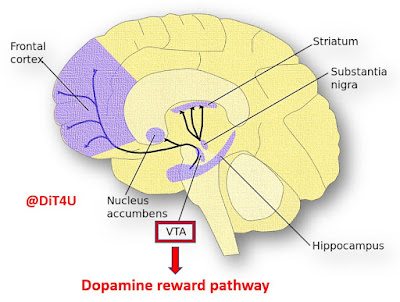
When nicotine enters the bloodstream it activates what is known as the dopamine reward mechanism as shown here:

Dopamine is the 'feel good' brain chemical that activates the reward circuitry in the brain as follows: 

And so on it goes, until it becomes a vicious circle.

This makes tobacco/nicotine one of the most addictive substances in the world - the reason why quitting smoking is such an onerous task, fraught with relapses after periods of abstinence. 

However, breaking this reward circuit by associating less harmful substances (such as caffeine) with the pleasurable feeling, may work in some cases.  

Or, one could also try associating nicotine with unpleasant consequences such as odourous breath or health issues such as coughing/breathlessness. 

Yoga, pranayama and meditation, if done under guidance, can help break this vicious circle by helping one focus on larger issues rather than resort to smoking as a coping mechanism.

I talk about smoking addiction, complications due to long-term smoking, and treatment of smoking addiction in these videos in three languages:

English: https://youtu.be/OQmymTjteyg

Hindi: https://youtu.be/eCks5TGFfuk

Kannada: https://youtu.be/mhLfLL1xvl8

Please read more about smoking and what works in the treatment of its addiction in my earlier articles (click on the links from these pages to external site):

Harmful effects of tobacco10 ways to quit smoking and why e-cigarettes are no better.  

Also read a similar article on alcohol addiction.


Resources:

Music: Bed and Breakfast, The 126ers

Pictures:

  • https://researchoutreach.org/wp-content/uploads/2019/06/shutterstock_1119286277.jpg
  • https://upload.wikimedia.org/wikipedia/commons/thumb/d/de/Dopamine_pathways.svg/1200px-Dopamine_pathways.svg.png
  • http://b.vimeocdn.com/ts/435/029/435029196_640.jpg
  • https://62e528761d0685343e1c-f3d1b99a743ffa4142d9d7f1978d9686.ssl.cf2.rackcdn.com/files/20244/width1356x668/h5pht2cy-1360802054.jpg
  • https://upload.wikimedia.org/wikipedia/commons/thumb/9/94/Nicoderm.JPG/330px-Nicoderm.JPG
  • https://www.publicdomainpictures.net/pictures/70000/velka/electronic-cigarettes-1387647695FRV.jpg


Monday, June 14, 2021

Lakshmi Nrusimha Karuna Rasa Stotram

Sri Adi Shankaracharya composed this hymn to address Lord Lakshmi-Narasimha (God Narasimha along with his divine consort, Goddess Lakshmi).


https://youtu.be/0LSU08ATs24


Lord Narasimha is the fourth avatara of Lord Vishnu who appeared in the court of King Hiranyakashyapu to help His bhakta, Prahlada.  He is known to be the angriest avatara of Lord Vishnu who ripped apart Hiranyakashyapu.  

He could be placated only by the ardent supplication of Goddess Lakshmi and Prahlada. 

Adi Shankara himself is said to have been saved by the Lord when a kapalika sought to behead him.  

In this stotra Adi Shankara takes the position of a supplicant who is beseeching the Lord to guide him through the temptations and travails or samsara, or worldly existence.

Each of the seventeen verses ends with the refrain, Give me Thy hand O Lord!  Hence it is also called Lakshmi-Nrusimha Karavalambam Stotram. 

Reciting this stotra regularly is said to reduce anger and related negative vibrations, leading one to bhakti and peace.

For the literal meaning of the stotra please visit the websites listed below.


References:

Meaning:

  • http://www.hindupedia.com/en/Sri_Lakshmi_Narasimha_Karavalambam
  • https://templesinindiainfo.com/sri-lakshmi-narasimha-karavalambam-stotram-lyrics-in-english-with-meaning/
  • https://stotram.co.in/lakshmi-narasimha-karavalamba-stotram/
  • https://greenmesg.org/stotras/narasimha/lakshmi_nrisimha_karavalambam.php

Music: Tratak, Jesse Gallagher

Pictures:

  • https://upload.wikimedia.org/wikipedia/commons/7/7e/Lakshmi_Narasimha_statue_at_Cheriyal_temple%2C_December_2018.jpg
  • https://blogger.googleusercontent.com/img/b/R29vZ2xl/AVvXsEhLBTEzln3MupM_PnhlfjhbAfkikvZ2mPPs6AHDvokXBXBVq0Il3_5Zd4JM7xsZhE9ntb7tLhce1Ng_Um1c1p-GlgB37oWuB3Eoi9U3BeTDH7BFf_LJpP7mIQu2bCdyop0MIWo-qhKzo2Aq/s1600/chakra.jpg

🛕No Country for the Oldest Religion🛕

I am a citizen of India, living in India. I belong to neither the right wing nor the left wing. If anything, I am 'truth wing' - a c...